Category : market monetarism

Moj demand shock je supply shock za susjeda

Kad sam pisao post o devalvaciji kune (možda bi bolje bilo pisati “rastu tečaja” kune jer nije sigurno koliku promjenu zagovaraju pristaše devalvacije), na kraju sam se dotakao pitanja izvoza kao realnog (supply) shocka.

U 2009. i izvoz je doživio i veći udar od domaće potrošnje. Smatram da je to jedan realni negativni šok gospodarstvu na koji HNB ne može djelovati. S druge strane Lars Christensen ne misli tako. Kad sam to implicirao, odgovorio mi je ovako: 

 All demand shocks are monetary shocks and it actually follows from the so-called Sumner critique. Lets say that the demand for wood products increase. That would tend to strengthen the Latvian lat. The central bank then will have to choose whether or not that should lead to an increase in aggregate demand. If the Latvian central bank is targeting an inflation target or an NGDP target then it will off-set the export impulse by targeting monetary policy and as a consequence there would be no impact on aggregate demand.

Sumner (ne mogu više naći post za linkati) je dao primjer drvne industrije u Latviji koja je doživjela pad izvoza (realni šok) zbog recesije u Eurozoni gdje izvoze drvo (monetarni šok). Lars je dao primjer rasta izvoza drva. No, HNB ne cilja ni inflaciju ni NBDP pa smo vidjeli utjecaj na agregatnu potražnju i zbog šoka izvozu. 

Sumner ima post koji se bavi sličnim pitanjem u Kanadi. Ne tvrdim da su Kanada i Hrvatska iste, no možemo vidjeti paralele kad pričamo o “uvezenim” šokovima. Sumner tvrdi da je pad uvoza za Kanadu imao efekt realnog šoka. Jednako tako je ciljanje inflacije uvjetovalo BoC da negativno utječe na NGDP. U Hrvatskoj, osim realnog šoka (u međuvremenu šokova), ciljanje tečaja, kao i time omogućeni uvoz restriktivne monetarne politike ECB-a imao slične posljedice. Vremenski slijed u Hrvatskoj je najvjerojatnije nešto drugačiji nego u slučaju Kanade. Je li HNB mogao djelovati – naravno*. U tom slučaju recesija u Hrvatskoj bi bila bliža onoj npr u Švedskoj, doduše zbog niza “supply constrainta” nešto dublja/produženija. 

*Kao i u postu o “devalvaciji” napominjem da bi djelovanje značilo i promjenu načina provođenja monetarne politike, diskrecija bi bila veoma loša stvar u tom slučaju
Read More

Draghi jučer, Polleit i EMH

Jučer je Upravno vijeće ECB-a odlučilo ipak zadržati kamatnu stopu (MBR) na 0,75%. Postoji više razloga zašto bi bilo dobro da je snižena, no jednako toliko i za zadržavanje. U trenutku kad je ECB prešao na tzv. FRFA (fixed rate full allotment) proceduru (listopad 2008.) EONIA – stopa koju ECB efektivno cilja, tj trebala bi bili blizu MBR-a, je pala sve do Deposit Facility-a (doljnjeg praga za kamatne stope), koji je u medjuvremenu 0%. Nesto slicno se dogodilo i u SAD-u kad je Fed uveo IOER (interest on excess reserves). Tako ostaje pitanje ima li smisla snižavati MBR kada je EONIA već bitno niža. Naravno, tržište novca je “stjerano u kut” te većina likvidnosti ide preko Eurosystema, tako da bi snižavanje stope možda i pomoglo Njemačkoj, kojoj baš i ne treba ekspanzivnija monetarna politika. Prijenos signala monetarne politike u ostalim zemljama je više-manje zamagljen divergencijom kamatnih stopa na državne obveznice. Ne zaboravimo da kamatne stope nisu dobar proxy za stav monetarne politike. No osim same stope, zabrinjava Draghijev stav prema inflaciji i NGDP-u. 

Prognoza za HICP je oko 1,3% što pokazuje da monetarna politika ne radi svoj posao, čak ni za tako, relativno loš pokazatelj. S druge strane to znači da rast NGDP-a neće doseći ni 1%. To ne bi bilo loše kad ne bi bilo onog detalja iz 2008. kada je NGDP zaronio i nije se vratio nazad. Jedna od važnih stvari koju market monetaristi naglašavaju je  “target the forecast”. Ako Draghi vidi da će indikatori pokazati restriktivnost politike, trebao bi reagirati, ako ništa najavljujući da će učiniti što je moguće da pogodi cilj inflacije. Čini se da se Draghi pomirio sa ovakvim razvojem događaja, to je naravno i jedan od featurea monetarnih režima koji ne moraju nadoknaditi za prošle greške. Najava očekivanog oporavka krajem godine tu neće učiniti mnogo.

ECB-ova strategija dosta pati zbog fokusa na banke. Obično se to opravdava činjenicom da su banke izvor većine financiranja u Eurozoni. To nije netočno, no jednako tako, u doba wholesale financiranja, tržišta postaju biti sve važniji izvor financiranja banaka.

Jedna od “dobrih” izjava je bio Draghijev osvrt na tečaj. Puno se priča o “ratu tečajevima”, posebno nakon i ulaska BoJ-a u pokušaja deprecijacije Yen-a. Čini se da je nova administracija nešto hrabrija pa je odlučila poslušati glasove kao što je moj. Postavljajući cilj za inflaciju, Japanci su napokon odlučili izaći iz perioda 0% rasta NGDP-a. Deprecijacija valute je svojevrsni “side-effect” jednako kao kod i dollara. Već sam objašnjavao zašto kanal konkurentnosti nema smisla, što je bitno, je povrat monetarne stabilnosti.
Draghi računa na jačanje globalne potražnje u drugom dijelu godine za jačanje i gospodarstva Eurozone. Očito neće imati ništa protiv uvoza monetarnog easinga Fed-a i BoJ-a. Nijedna deprecijacija dosad nije imala primarno djelovanje kroz izvoz već kroz domaću potražnju, žalosno je da još danas neki zagovaratelji deprecijacije navode jači izvoz kao rezultat deprecijacije. U Eurozoni će se najviše žaliti Francuzi, no upravo bi oni mogli profitirati od povećane potražnje za potrošačkim dobrima na globalnoj razini.

Polleit na N-TV-u

S druge strane, na njemačkom N-TV-u je gostovao Thorsten Polleit davajući svoju procjenu djelovanja globalnih monetarnih vlasti. Kao i većina austrijanaca , on smatra da je monetarni easing pokušaj vraćanja pretkrizne strukture ekonomije i da tržišta kapitala “puše” priču iz FED-a i ECB-a. Ako razumijete njemački, video možete vidjeti ovdje. Naslov je “Wir brauchen keine Notenbanken” što znači “Ne trebamo središnje banke”, a to je nešto s čime bi se i ja složio. Složio bi se i sa činjenicom da su upravo one krive za današnje stanje. Složio bi se i sa činjenicom da tržište nije i ne može biti krivo za krizu. Ne bi se u potpunosti složio s činjenicom da su “easy money” i “rates held too low for too long” krivci za pretkrizni boom. Nisam napisao u potpunosti jer je prije krize bilo malo overshootinga NGDP-a što je pokazivalo da monetarna politika trebala biti nešto restriktivnija. Polleit navodi da je potrebno zaustavljanje rasta monetarne baze i guranje gospodarstava u recesiju kako bi se očistilo tržište. Ja nisam u to uvjeren, a to je zato jer ja vidim restriktivnu monetarnu politiku 2008 kao rezultat uzrok dramatičnog pada NGDP-a. Isto tako mislim da su tržišta efikasna i da nije potrebna depresija kako bi se tržišta očistila. Realokacija je moguća i u stabilnom monetarnom okruženju kao sva ova desetljeća od posljednje slične velike greške Fed-a. Zanimljiva je ta razlika u viđenju tržišta između market monetarista i nekih austrijanaca. Austrijanci smatraju da Fed vuče tržišta za nos kreirajući još jedan mjehur, market monetaristi više vjeruju u EMH i racionalna očekivanja smatrajući da tržišta trebaju biti indikator za provođenje monetarne politike – kao što je Sumner nedavno rekao kako bi tržišta trebala Bullarda vući kao vola za lancem privezan nosni prsten. Ukratko ideja market monetarista je da je bolje “vidi” više milijuna glava nego jedna. Inače Polleit ima jako dobru knjigu (udžbenik) koji toplo preporučujem. To je valjda prvi malo jači moderni udžbenik u kojem se spominje Austrijska škola.


BTW jeste čuli da je Krugman bankrotirao?

Read More

Kamate, Inflacija i provođenje monetarne politike

Kolega s bloga Strašilo ima post koji povezuje nisku kamatnu stopu i inflaciju u Hrvatskoj. To je relativno konvencionalno razmišljanje o samoj inflaciji kao monetarnom fenomenu i cilju modernih središnjih banaka, kao i dosezanja istog cilja ciljanjem kamatnih stopa. Evo par mojih misli na tu temu.

Milton Friedman je prije nego što smo svi postali “osviješteni” nakon 80ih izjavio “Inflacija je uvijek i svugdje monetarni fenomen”. Pitanje je koja inflacija? Povećanje cijena zbog promjena u strani ponude možda ne bi smjeli zvati inflacija, ali greška modernih središnjih banaka je da se fokusiraju na takve promjene ciljajući nekakvu košaru u formi CPI-a. Tako sada o inflaciji pričamo u slučaju inflacije monetarne mase i npr. rastu cijena koji je pruzročen tsunamijem.

Činjenica je da su određene komponente više pridonijele rastu indeksa cijena u Hrvatskoj od drugih. Prije svega to je pitanje cijena energije. Početkom 2012. značajno je podignuta cijena električne energije, jednostavnom administrativnom odlukom vlade. To je povećalo pritisak na inflaciju (CPI) u Hrvatskoj, kao što pokazuje HNB-ov bilten
Tu se i kolega slaže. Quotati ću njegov komentar da otprilike vidite o čemu se radi.

OK, istina je da ne baš sama opća razina cijena, ali sam indeks može porasti i iz razloga državne odluke

ali ja tu odmah vidim nekoliko problema, konkretno, najlakše je ustvrdit nešto tipa, da, ali par godina prije nisu podizane cijene kada su trebale bit već je državna firma snosila dio troška inflacije i sada su cijene na onoj razini na kojoj bi ionako trebale bit 

činjenica je da opća razina cijena divlja, i iako tržište novca u hrvatskoj nije nešto razvijeno, ipak bar u velikoj mjeri prikazuje rezultate monetarne politike i koliko ima “viška”/”manjka na tržištu” 

tu sam još davno htio pisat o tom HNB-ovom cilju, jer oni imaju zakonsku obvezu održavat stabilnost cijena, a inflacija od 4% nije stabilnost cijena

da stvar bude gora, ta zakonska obveza je tu da bi bili usklađeni s ECB, a tamo je to (ili je bar bilo prije par godina 2%)

siguran sam da imaju neku uredbu ili što već na temelju čega je to savršeno legalno, no ostaje činjenica da krše minimalno duh zakona na temelju kojega postoje


Njegov komentar u biti i predstavlja strukturu nastavka teksta – pitanje izvora inflacije, kamatnih stopa kao instrumenta monetarne politike i pitanja zakonskog reguliranja cilja monetarne politike.

U principu ima pravo sto se tice “tajminga”, postojao je negdje u publikacijama HNB-a graf tih cijena gdje se jasno vidjela razlika između Hrvatske i EU zemalja (ako netko nađe neka linka, hvala). Dio rasta cijena je naravno monetarna strana (na globalnom nivu) ali ni blizu sve. Na primjeru HEP-a – naglim povećanjem cijena akomodirana je neefikasnost državne firme i troškovi su preneseni na kupce (doduše dio su i globalni supply side faktori). Jednako tako, rastom stope PDV-a akomodirana je neefikasnost države u pružanju svih usluga – plaćamo više za isto. To je nešto na što monetarna politika ne može utjecati, nit bi smjela pokušavati. Ono na što je želim staviti težište u ovom postu nije samo pitanje uzroka inflacije, već pitanja odnosa monetarne politike koja cilja inflaciju i samog cilja – inflacije.

Stabilnost cijena ne podrazumjeva samo promjene stope trenda kroz vrijeme. Kada pričamo o stabilnosti cijena, ekonomisti obično podrazumjevaju i manju volatilnost cijena. Recimo, Velika moderacija nije period (samo) niske inflacije vec stabilne inflacije (kao i outputa) u smislu volatilnosti. Ima mnogo razloga zasto je 2% “optimalna” inflacija, no to je relativno nov fenomen, više-manje povezan s Greenspanovom erom  – tek je Bernanke artikulirao 2% kao cilj. Eurozona ima cilj od “manje ali blizu” 2%. 


Ako preferiramo “austrij(an)ski” stav o inflaciji u smislu gubitka vrijednosti valute – prebacimo se u nekakav “productivity norm” svijet. Tu je bilo koji nivo monetarne inflacije nepoželjan. Tada je, pojednostavljeno, (ciljana) inflacija (demand side – uzrokovana povećanjem monetarne mase u odnosu na potražnju) efektivno 0, a ekonomija je u deflaciji koja je rezultat povećanja produktivnosti (supply side). Deflacija bi bila jednaka rastu produktivnosti. Čak i u tom svijetu, pad efikasnosti monopolističkog agenta dovodi do povećanja (u biti smanjenja, ali zamislimo deflaciju kao trend ispod 0) stope deflacije, tj percepcije rastućih cijena (cijelog indeksa) u odnosu na prije. Kao što sam rekao, to je nešto na što središnje banke ne bi trebale reagirati jer je velika vjerojatnost da će imati negativne efekte na alokaciju, a makro efekti će i u kratkom roku biti nepovoljni. Ako pogledamo rezultat Bernankeovog ciljanja inflacije 2008. možemo reći da su efekti već i dugoročni. U lice s povećanjem cijena koje je rezultat negativnog šoka ponude (i negativnog utjecaja na realni rast), monetarna politika koja cilja inflaciju će pokušavati smanjiti domaću aktivnost, koja je već pod negativnim utjecajem negativnog supply šoka.


Hrvatska, kad/ako uđe u eurozonu, dolazi pod palicu ECB-a kojemu je cilj, kako kolega navodi, 2%. To je naravno mjera HICP-a za cijelu eurozonu. Možda će u Hrvatskoj inflacija mjerena HICP-om i nakon toga biti 3-4%. To naravno nije razlog da ne preferiramo inflaciju od 2%, onoj od 4%. Ostaje pitanje kako je mjeriti i kako ostvariti cilj, te kako to zakonski regulirati. Lars Christensen ima ideju kako ostvariti cilj.


Kamatne stope nisu stav monetarne politike
S obzirom da sam do posta došao jer sam kliknuo na Friedman tag na blogu, možda bi bilo dobro iskoristiti njegove riječi za ilustraciju cinjenice da kamatna stopa nije dobar pokazatelj stava monetarne politike: 
Low interest rates are generally a sign that money has been tight, as in Japan; high interest rates, that money has been easy. 
. . . 
After the U.S. experience during the Great Depression, and after inflation and rising interest rates in the 1970s and disinflation and falling interest rates in the 1980s, I thought the fallacy of identifying tight money with high interest rates and easy money with low interest rates was dead. Apparently, old fallacies never die. 
Problem je što većina ljudi kamatne stope gleda kao nešto čime se bavi središnja banka, a ne kao tržišni fenomen. Oni koji to razume – zarađuju, tako je Goldmanov Lloyd Blankfein u Davosu izjavio kako će kamatne stope narasti onda kada tržište to kaže.
Niske kamatne stope ne moraju biti znak nadolazeće inflacije. Upravo iz razloga koje sam naveo prije, tj na primjeru Hrvatske, gdje kamatni kanal u principu i ne postoji, pa kad se i spuste stope na tržištu novca, to ne stvara nikakav efekt na cijenu kredita s obzirom da je ona zadana na drugi način. Nije stvar nerazvijenosti tržišta, vec činjenice da HNB uvozi monetarnu politiku ECB-a tako što drži tečaj “stabilnim”. 
Naprotiv, upravo su visoke kamatne stope (c.p.) inflacionarne jer povećavaju brzinu obrtaja novca.

Kamatne stope su relativno “nov” način provođenja monetarne politike, a posljednjih 20 godina posebno povezan s formulacijom Taylor rulea. Fokus na kamatnu stopu je u biti rezultat keynesijanskog prodiranja u mainstream ekonomiju krajem 80ih. Nakon financijskih inovacija 80ih volatilnost obrataja novca (money velocity) je uvjetovala neuspjeh Friedmanove ideje da se cilja M2 novčani agregat. S druge strane serija znanstvenih radova u SAD-u je pokazala da monetarni agregati gube vezu s realnim varijablama dok kamatne stope utječu na realne varijable. Danas znamo da to nije istina i da je ovaj način razmišljanja rezultat lošeg mjerenja monetarne baze. Ireland i Belongia to pokazuju to koristeći nove DIVISIA monetarne agregate. Hoću reći da je fokus na kamatne stope zapravo rezultat lošeg mjerenja agregata više nego uspjeh monetarne politike vođene ciljanjem kamatnih stopa. 
Kamatne stope, kao i tečaj su rezultat upravljanja monetarnom bazom. S obzirom da je monetarna baza loš instrument za ciljanje , Woolfordova biblija je skupa sa popularizacijom Taylor rulea kao izvora Velike moderacije, kamate uvela u priču o središnjim bankama. Zašto po meni to nema smisla djelomično sam odgovorio, a povezano je i s činjenicom da se središnja banka zapravo ne bi uopće trebala povezivati sa bankama a o tome više drugi put.

Stav monetarne politike predstavljaju NGDP i inflacija, a ne kamatne stope. Da se kratko vratimo na Hrvatsku – dok kolega smatra da je rastuća inflacija rezultat HNB-ove ekspanzivne poltiike, ja se ne slažem. Quotati ću vlastiti komentar:

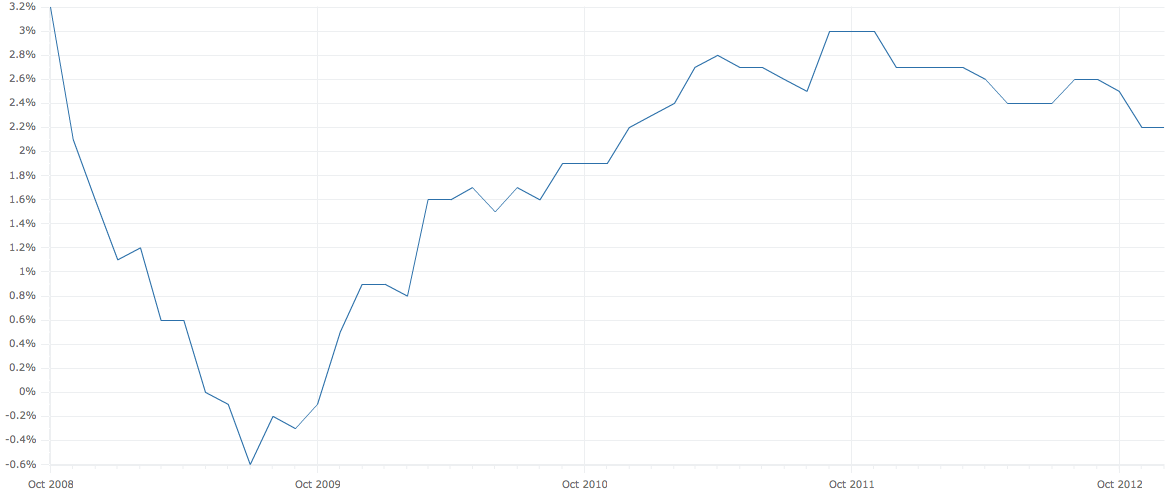
Inflacija u 2012 u RH je prije svega supply side, tj negativni supply sok koji je proizvela drzava intervencijama u porezni sustav i nagle promjene cijena koje kontroliraju drzavna poduzeca (poput el.energije). Na takve sokove sredisnje banke ne bi smjele reagirati jer sredisnja banka po svojoj definiciji ne moze ni utjecati na supply side faktore. To je nesto s cime bi se slozili i free bankeri poput Georgea Selgina. Kad bi pretpostavili da HNB ima definiran cilj za inflaciju (do 2008 oko 4%), ispunjenje istog bi najbolj pokazao GDP deflator (jer obuhvaca sve cijene a ne kosaru) vidjeli bi da je HNB profulao cilj. evo nekakav prikaz kako to izgleda


Iz moje perspektive, monetarna politika u Hrvatskoj nije ekspanzivna već suprotno.

No, konkretno gledajući, tu će već doći do prijepora izmedju monetaristickog i austrijanskog vidjenja situacije, a to je već tema za šire rasprave kojih ima dovoljno po netu. 
Što se tiče samog reguliranja stabilnosti cijena, kao zakonski definiranog cilja monetarne politike – kao što sam već napisao, nije cak većinska važnost ostvarenja cilja na nekoj stopi (ukoliko ista nije eksplicitno definirana). SAD imaju stabilnost cijena kao jedan od ciljeva vec desetljecima, a 2% usidrene inflacije je fenomen koji se povezuje s Greenspanom i ranim 90ima. Zlatni standard je osigurao istu kupovnu moć više stoljeća, no to ne mijenja činjenicu da su cijene bile jako nestabilne. Zakon ne definira kvantitativno što je stabilnost cijena (kao ni punu zaposlenost, ako pričamo o SAD-u) Jedan od razloga je što, za početak postoji veći broj mjera inflacije. Dok Fed fokus drži na PCE indeksu (koji opet ima više verzija), u novinama se često navodi i CPI, a može se koristiti i BDP deflator itd. Već sam objasnio zašto smatram da je BDP deflator među boljim indikatorima – činjenica je da obuhvaća sve cijene finalnih dobara i usluga proizvedenih u zemlji, a to je puno bliže nečemu što monetarna politika može utjecati. CPI ima i problem da su ponderi utjecaja pojedinih komponenti statični kroz vrijeme dok se struktura potrošnje uvijek mijenja.  O prihvatljivoj volatilnost ciljanog indeksa bi bilo i suludo špekulirati. 
Monetarna politika temeljena na pravilima a ne diskreciji
Vratimo se na zakonski okvir – ja sam u komentaru izrazio da problem dolazi iz činjenice da nezavisnost središnje banke omogućava širok prostor svakakvim interpretacijama kako ciljeva tako i pitanja provođenja monetarne politike. Diskrecija u vođenju monetarne politike koja se odvija zadnjih 5-6 godina je zastrašujuća. Kako bi se s zakonske strane regulirao rad središnje banke nije bitno zajamčiti neovisnost već kvalitetnu strategiju monetarne politike – provođenu pravilima (rules based), inkorporirati u neku vrstu monetarnog ustava i monetarne politike provođene pravilima. Kao što kaže Lars Christensen,

We want central banks to stop the ad hoc’ism. In fact we don’t even like independent central banks – as we don’t want to give them the opportunity to mess up things. Instead we basically want as Milton Friedman suggested to replace the central bank with a “computer”. The computer being a clear monetary policy rule. A monetary constitution if you like.

The problem with today’s monetary policy debate is that it is not a Buchanan inspired debate, but a debate about easier or tighter monetary policy. The debate should instead be about rules versus discretions and about what rules we should have.

Read More

Kapitalizam iz sjene: Jutarnji list otkrio neoliberalnu zavjeru u jednoj zagrebačkoj pivnici

Već sam negdje pisao da je blogosfera potencionalno moćna stvar. Kao što je eventualno Scott Sumner sa bloga proširio tržišni monetarizam u glave najvažnijih monetarnih ekonomista svijeta (doduše još nigdje u praksu), jednako tako se nadamo da će nakon ovoga hrvatska javnost napokon imati priliku pobliže spoznati drugu stranu priče što se tiče mita o “neoliberalizmu” koji je opustošio Hrvatsku. Mislim da je ovo prvi put da uopće vidim izraz “libertarijanizam” i “libertarijanci” u hrvatskim novinama. Najvjerojatnije, ovo je i prvi put da je market monetarizam spomenut u nekom hrvatskom glasilu.

Za one koji ne znaju što govorim neka posjete blogove kolega u blogrollu s desne strane i prime svoju dnevnu dozu zdravog razuma!

UPDATE: Evo i online verzija
Read More

Blogroll update pt.2

Posljednje vrijeme su se stvari nesto ubrzale s blogganjem, htio ja ili ne, blogosfera me uvukla u priču koja je veća od običnog zapisivanja misli. Kad se mali bloggeri slože rađaju se zanimljive ideje, rasprave i prilike. Pošto se davno nisam bavio uređenjem bloga, odlučio sam za početak ponovo updeatati blogroll kako bi čitatelje uputio na neke zanimljive destinacije na net-u i zahvalio se pojedincima što su to isto učinili s poveznicom ovog bloga. 

Market monetarizam sve više hvata zaleta na svjetskoj ekonomskoj sceni, i bilo bi neodgovorno od mene ne uključiti neke od destinacija koje redovito posjećujem, kao što su 
Historinhas Marcusa Nunesa – “brazilca koji voli grafove”. Kao što sam već “oglašavao”, Marcus je zajedno s financijskim novinarom Benjaminom Coleom napisao prvu knjigu o market monetarizmu;

Monetary Freedom – Bill Woolsey ima zanimljiv pogled na aktualne teme, većinom teoretskog karaktera, koji jako dobro izloži;

Dajeeps – Politics, History, Economics – Bonie Carr je u tech biznisu a u blogu piše o mitovima financijskih mjehura, monetarnoj politici, društvu, a uz svoje misli je nesebično podjelila i recepte za neka jela.

Što se tiče hrvatskih bloggera, tu je Vuk Vuković, “naš” ekonomist koji ipak piše na engleskom, s radovima objavljenima na svim važnijim svjetskim ekonomskim destinacijama, možda ste već posjetili njegov blog ako ste pratili naš (njegov, moj pa i vaš) razgovor o mogućnostima NGDP level targetinga. Evo i link: Dont Worry, I’m an Economist .

Darko Polšek kojeg sigurno poznajete kao komentatora t-portala, ima (doduše jedan od više njegovih destinacija) blog o širokom spektru tema, za one koje zanima malo više od ekonomije –  Prokleta avlija / Alley of the Damned 

Za komentare na najnovije nepodobštine hrvatskih centralnih planera, posjetite blog kolege Kapitalca, a kome više odgovara tjedni ritam, ne propustite Nedjeljni komentar.

Ekipa koju više zanimaju tržišta kapitala, stanje domaćih poduzeća i ulaganje će sigurno posjetiti Eclecticu Nenada Bakića.
Read More

Structural or demand shock, we still need NGDP level targeting

So, I finally got some time to collect my ideas about Vuk’s latest post on market monetarism in one post. The main question was if NGDPLT (NGDP level targeting) can bring major economies out of current slump. Vuk believes that, structural shock being the main reason we are (still) in the slump, monetary stimulus cant’ help a lot. On the other side, my view is that CBs (central banks) caused a big part of the slump by conducting overly tight policy in face of the heightened money demand. I do not deny there arent any structural problems, as you will read in the rest of the post. Unfortunately for everyone, I have some problems focusing and that’s why I write this much instead of writing a comment on the post. I always cram my posts with some additional ideas I may have. One good thing for me i that this way I may get a feedback from Vuk (or anyone else reading the posts).

Structural shock, politics and ECB

I was so sure you’re going to take up on that sentence, but I put it in anyways, for the sake of the debate :D.
You remember, in my post, I wrote,  I had a “moral” problem. It was exactly the point you made about making things easier for irresponsible governments. Unlike some other of my colleagues, Im a bloodsucking neoliberal who knows governments never learn, especially when they have strong backing by the media and general public opinion about bloodsucking free market prophets such as  myself. Pain is sometimes necessary, but how much/long? If part of it was caused by monetary policy, that part must be resolved. Thats where my problem with the whole thing lies. 
Some progress in reforms in EU has been made. At the same time additional  taxes, regulations, “rescue”/transfer” funds will act as a brake for the positive labour market reforms, privatizations and other moves being made. What the world needs is a stable monetary environment, with clear goals and instruments to reach them. And this is where I believe NGDPLT is important (not perfect), it is a policy rule that is neutral. A lot of metrics are getting distorted today because the fall in NGDP was that drastic (like Greek debt/gdp), if NGDPLT was implemented, things would have looked a lot different today. I know we are talking of the effects of the NGDPLT as a short term stimulus, but I find it just hard to asses it from that short term point of view.
Other thing is that I dont believe in “growth models”. Maybe I dont understand what you mean by the term. I think markets determine where they want to go. I guess you can call this stance a clear belief in EMH. Only model we should think about is the model of  institutional setting for the future. Same as rule based monetary policy (favorably NGDPLT), public policy (institutional reforms) should follow the same idea. And this is something where Noah Smith (quote) had an idea, but lost it to fiscal multiplier. If the path of reforms is more or less secure, and not under threat every time a new government steps in (I think Scandinavian countries are a prime example last 20yrs) public policy can influence and stabilize long term expectations for agents. Now the pressure from the “Troika” is doing that, but the equilibrium between sides is very fragile. We see what corruption allegations are doing to the credibility of Spanish PM and reform policies. As Lars Christensen puts it
On the other hand if the ECB moves back to the bad habit of conditioning monetary policy on political outcome then once again the markets will start worrying about the finer details of Italian and Spanish politics.
That’s obviously a problem. With NGDPLT markets wouldn’t probably be focused on that so much. It would be easier to asses how much of the stress is reall ycaused by the irresponsibility of governments. The problem of PIIGS yields is the problem of ECB conducting monetary policy trough a interest rate channel – hence the need for institutional reform in this environment. I dont even want to talk about fiscal multipliers, for me, its such a terrible concept, because, unlike neutral monetary policy it is a very clear intervention in allocation. In the most simple words, in market monetarist view, fiscal multiplier is 0, since NGDP or inflation targeting bank will offset any rise/fall in AD caused by fiscal side – this is known as the Sumner critique, and also this is a part of explanation what is happening today in Europe. 

Draghi’ promise
Regarding “Draghi’s promise”: most of the uncertainities about market conditions (yields) were relieved. I never claimed anything structural changed in the economy of Spain. Notice here, I dont even dispute the notion that there are structural problems that need to be solved, and that ECB won’t be able to solve them. Some of the problems are directly related to institutional setting of the Eurozone, and this is something where ECB can give “recommendations”, but it can’t solve them. I have some ideas how NGDPLT could help overcome some of the challenges arising from the current Eurozone setting, but, more about it some other time.
You can take a look at the effects on business/consumer confidence. But I refered to Draghis words relating to the markets – financial markets.
Here are Spanish yields from a Rabobank report, question is will it last, especially regarding to the previous paragraph. Rabobank people, as you can see consider the falling yield and CDS as part of “Looking to OMT”. In a way they are right. But on the other side, markets would push Spain over the cliff to OMT (ESM) if they deemed it was necessary, but they went other way – doing most of Draghis work.  The logic of OMTs in a way showcases the Sumner critique.

But, what I believe to be more important is the Target 2 balance, showing that situation of “internal” Eurosystem payments are beginning to stabilize, after Draghis “promise”. I saw this situation as one of big risks for the Eurozone (Eurosystem).

Regarding consumer/business confidence, as I said, I dont think you can get a lot from that data. Consumers don’t see monetary policy in terms of income ,yet 😉 , but in terms of inflation. Im no institutionalist, so in my view relative price signals are important for allocation of investment and stable nominal environment is critical then. In that sense Draghi has no effect on allocation, but ECB can influence stability. Consumer confidence can be strongly related to the performance of labour market, which by now is terrible. If monetary policy solved a big part of the NGDP gap, at least the part we can agree(?) it caused, situation on labour markets wouldn’t be like this.
Since a lot of “toxic” investments pulled down some healthy assets with them, we have a much wider crisis than was necessary. Dont forget subprime was 3% of the mortage market. Greek GDP was also 3%(?) of the Eurozone economy. Also debt/NGDP ratios wouldn’t explode as much, and healthy parts of the economy wouldn’t be starved because there is a need for cleansing of the malinvestments in some sectors.
And that is the part of the economy I am concerned with right now, those which are getting clobbered because there are some mistakes in the system. NGDPLT would solve a huge part of this.

The hot potato
The question is if you agree with market monetarist view that there is elevated demand for money (money and assets used as money) that isn’t satisfied. Also do you see inflation and NGDP as the best indicators of monetary policy stance? Its not the idea that Fed had tight policy, but policy was tight in face what was happening on the markets. Effectively markets were signaling tight policy and rising money demand.  MMs will argue NGDP fall shows this fact (tightness). NGDP was collapsing long before Lehman bankruptcy, you can’t argue that this huge fall in NGDP happened last 15 days of the quarter?

If you take a look at the money market spreads, you will see they were rising long before the Lehman collapse. Markets were screaming that money was tight.
Also don’t forget the problems of Feds primary dealer system, one can argue that even if the Fed saw what was happening, this could have been a bottleneck for future action. 
Now, lets take the hot potato idea to the extreme. Imagine CB bought all financial assets and then, it sets out to buy your house, gives you money for it and throws you on the street. I guess you would set out to buy a new house, flat, cardboard box etc. Off-course this is imaginary but illustrates the mechanism. From my perspective, CBs dont even have to try to throw the “hot potato” in terms of excess money. 
If Fed satisfies the elevated money demand + commits to a rule based policy as NGDPLT to ensure stable environment for endogenous money creation, especially in asset creation, it will fulfill its role in my view. I liked Nick Rowe’s “story”how (fiat) money is the only asset in all markets. If there is shortage of money, there is a shortage of realized exchanges relating to the possible optimum. I think it is enough to satisfy demand to ensure the monetary policy job is done, and then, maybe, you can think in terms of the following view of mine.
The big picture

l’ll give you a punching bag right now, but I imagine it looking like this.
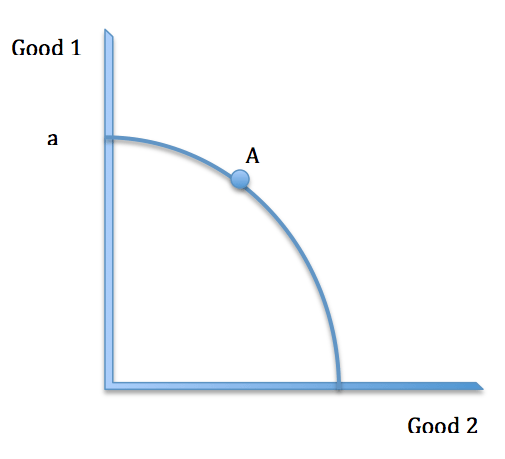
I visualize it like this – consider the graph showing nominal demand (a) which is determined by monetary policy. You may observe it as money supply versus money demand needed for that level of NGDP (equation of exchange). Lets say its a two good economy. On one axis is one good (investment) on the other, is the alternative good (investment). Lets arbitrarily say that A represents some long term equilibrium.  (I did this in word so it may look a bit crappy, Im open for suggestions on other tools to draw things like this)


B represents some supply shock induced deviation. Now, in NGDPLT monetary policy is neutral. It should keep the nominal demand stable on the path. All the reactions can happen in a stable nominal environment. Shaded are shows the distortion and the loss of the nominal income.

That results in move from a -> b.

Nominal income deviated from the path as a result. Now, in growth rate targeting regime (or inflation targeting), this would be fine and CB wouldn’t have to make up for the “mistake”. If you regard NGDP as a stance of monetary policy, b would mean the MP is tight. 
When the nominal environment deviates as well, you have a “double” problem, creating a sort of feedback loop. Nominal income falls – for example, cash flows from all MBS, not just those which were subprime or some other that are in “trouble” are affected. Now, general nominal AD may deviate from the “optimum”, but monetary policy doing the level targeting, will do everything to make up for the shortfall (and bring the situation back to a+level target in t+1). It will be easier to allocate resources from distressed sectors then. 

Now demand for subprime housing will decline, but other asset classes will not have problem with distressed prices. This crunch in a part of a market can occur if there is a general uncertainty (call it information asimetry?), counterparty risk on the markets, creating a vicious circle from market liquidity to funding liquidity, back to market liquidity and so forth, distorting all possible asset classes. In that moment money demand explodes further / velocity is falling. Then further decline (to point c) in nominal income because MP was tight is certain.


Why can’t the discovery of some other equilibrium/ return to A (if B was unsustainable) be easier in situation where money is tight? I think its because if some other healthy sector is affected by a fall in nominal income (tight policy – take a look at role of money in all markets) it will not be able to accommodate the adjustment.

If Fed responds to that money demand appropriately, it can prevent a widespread vicious circle we saw in 2008 and consequences of which people are still feeling around the world. Doing it now (from point c) makes it a lot harder, but NGDPLT can induce markets to do part of a heavy lifting as I was trying to show before.  “Good” parts of the economy will continue to function since monetary policy isn’t affecting relative prices but is targeting agregate nominal incomes and ensuring cash flows related with such investment (going at least to b, preferably to a). So if you are talking about MBS, those with cash flows from subprime borrowers will likely become “toxic” and the misallocation of resources caused by the idea of granting these people access to loans to buy homes will have to be resolved . I would call this the structural part. On the other hand, other securities may still be of “good”, primarily transparent,  value – because nominal incomes they generated and generated from them are not significantly affected by the crunch in the other market. Offcourse they wouldn’t be fully immune, but on the other hand these wouldn’t be caught in a firesales spiral caused by high money demand (think of Rowe’s story), which is not accommodated (to c). Lets call this “tight MP” part . (again, lets suppose some of primary dealers weren’t loaded with subprime MBS going bad)

I dont know enough about measurements of output gaps and will appreciate any of your or someone else’s input on my thoughts. Insofar we can agree that Great Moderation is a period from 1987, do you believe that, as you say, “unsustainable system” was created from that point? Then I see a reason to doubt the pre crisis path. 
If problems of unsustainability were “created” (unsustainability began to amass?)  at some other point later (1999 – with CRA; 2001-2003 rates too low for too long etc) than path of NGDP resulting created by the Great moderation doesn’t have to be questioned to the extent that “it wasn’t all bad” and maybe it can be continued – than there is some sense in trying to make up for past mistakes and continue the same path.
Now, lets return to the graph idea (if it has any merit) and think of it in terms of the shock. Basically, If we accept that level path US embarked on since the 1987 was in fact the begin of an unsustainable amassment of instabilities that culminated in 2007, then I see nominal AD, permanently falling to the level (b), acceptable. That would mean NGDP was above some long term trend from then.
Major CBs should go on with implementing NGDPLT, first by accommodating the risen demand for money to alleviate mistakes (fall to c) they made before (thereby not absolutely solving the slump and restoring it to the pre crisis path – since it was unsustainable). I would call this scenario “embracing the gap”. (Im presuming here you do agree part of the gap is tight MP)

Dont get me wrong, there were a lot of mistakes Fed did during these 20yrs, but lets say those were repairable and did not have long lasting effects – unless there are some, you believe are responsible for the excesses I mention in the next sentence. 
So, on the other side, if we accept that there were certain excesses caused by unsustainable policies (be it by Fed, Governments, of exogenous nature…) from some point during the Great Moderation to Q3/2008, and some of those can be seen as the “beginning” of the end for the system set up that way, do we really need to say, that underlying NGDP level path was totally unsustainable? Then I do see a reason for monetary policy to try to get to the pre crisis level path (a). Lets call this scenario “bridging the gap”. 
Even if there were periods of unsustainable growth, Im still not really convinced that it brings long term problems with it. Its not like Americans or Europeans became lazier, les innovative etc. There are restraints for future dynamism of US and EU economies stemming from the responses to the Crisis, but there is no reason why CBs shouldn’t start targeting nominal income and bringing it back to precrisis path. Also, another problem, the way I see it, is, that in case of a negative supply shock and monetary policy that responded appropriately , we would see a rise in inflation, which didnt occur.
If we say that structural shock is making this impossible (I see Europe being a bigger problem here), CBs can at least solve the problems they caused when they tightened the policy (back to b). 

In the end, our little debate is basically a debate of “how much”, or as you put it
My problem is on the perception of the rule itself (NGDPLT) as a credible enough mechanism to pull us out of a recession.
where I see switch to NGDPLT helping much more than you believe it can.
In that sense, MP can bring back the path at least to b, where I see you observing the c as the “new normal” until structural reforms are implemented – or b if you do agree that part of the problem is the tight MP.
NGDPLT, in my view, can’t resolve all the problems (as in my previous post, you see that I do agree with you on some underlying real growth problems resulting from the problems with the malinvestment “legacy”) but it will create stability for the unaffected parts of the economy as well as raise nominal incomes in terms of the output lost because of the monetary policy mistakes (tight stance). If only an ADshock happened, then great, if not,   then we will know monetary policy did all it could (and should). Returning to the pre-crisis trend in NGDP doesnt mean returning to the same patterns in the economy (B), it means ensuring conductive environment and an opportunity for these patterns to change (probably to A).
Regarding Bullards presentation, Sumner had posts (1, 2) so take a look.

UPDATE: Nick Rowe has a great story showcasing the hot potato, recession as a monetary phenomenon and basically a big part of my “big picture”

PS. Sorry for much of the spelling mistakes, autocorrect seems to have a mind of its own


Read More

Monetarizam na suncu

Opustanje na suncu uz Nunesa i Colea i prvu knjigu o market monetarizmu.

Review kad zavrsim 😀

Read More

Eurozona treba vrući krumpir, a treba ga i Japan

ECB je početkom 2012 proveo drugi dvogodišnji LTRO za ukupni volumen emitirane likvidnosti od otprilike 1 bilijuna EUR (1000 milijardi). Banke dio likvidnosti (oko 150 mlrd) žele vratiti i prvi rok je 27.02. Bloombergov članak kaže

ECB je spreman nadoknaditi svako ubrzanje u vraćanju ovih hitnih zajmova od strane europskih banaka kako bi osigurala da smanjena likvidnost ne ometa provođenje monetarne politike


No LTRO-i sami nisu učinili previše kako bi smirili situaciju, tek kombinirani sa Draghijevim riječima “da će učiniti sve potrebno” kako bi spasio Euro, su imali smisla. Snažna privrženost Euru koja je iskazana tim riječima je pokazala tzv. Chuck Norris efekt monetarne politike – ona situacija kada tržišta učine veći dio posla. Nešto o tome možete pročitati u ovom postu.


Vratimo se LTRO-ima. Siguran sam da je jedan od razloga ovolikog interesa za povrat sredstava, pa čak i od Španjolskih banaka, činjenica ukidanja kamate na rezerve kod Eurosystema (Deposit Facility) – tj smanjivanje kamate na 0 kod posljednjeg smanjenja kamatne stope na operacije refinanciranja (the kamatne stope). Dugo vremena je stopa na Deposit Facility bila 0,25%. U trenutku snižavanja na 0 nastaje oportunitetni trošak držanja tolikih sredstava do isteka operacije (2015. godina). Banke su očito zaključile da je isplativije vratiti neka sredstva nego ih ulagati u alternativne mogućnosti. Ukupno gledajući, uz Draghijevu izjavu, smanjivanje ove stope je imalo pozitivne efekte na tržišta Eurozone. To je jedan od razloga zašto vraćanje ovih sredstava, koje je efektivno poništavanje novca zabrinjavajuće

Vidimo zašto LTRO nije “vrući krumpir”. Ideja vrućeg krumpira (vjerojatno postoji bolji hrvatski izraz?) je ono što je ECB trebao postići s ovim operacijama – ekonomske agente, koji već imaju visoku potrebu gomilanja likvidnosti – namiriti s tom likvidnošću i proizvesti situaciju gdje imaju više novca nego što žele držati. Tada je najracionalnije što mogu učiniti  – potrošiti ga, rješavajući problem kolapsa agregatne potražnje.

Problem ECB-a je potpuna fokusiranost na kamatne stope u situaciji kada iste nemaju nikakvog efekta. Najave o vraćanju LTRO novca su počele podizati kamate na tržištu novca, i to je ono što bi ECB moglo navesti na dodatne akcije, tj to je priča iz Bloomberg članka gdje povratak likvidnosti ometa provođenje monetarne politike. Još gora greška ECB-a je činjenica da ima preveliku usmjerenost na tržište novca i kratkoročne kamatne stope. Kamatne stope nisu dobar indikator stava monetarne politike (sjetimo se Japana od 90ih do danas) . Čini se da je ECB zanemarila svoj drugi stup monetarne analize i pitanje razvoja monetarnih agregata kao i potražnje za novcem. 
Zašto je ECB slijepa? Pa jednostavno, ECB smatra da je cilj monetarne politike stabilnost cijena. ECB inflaciju mjeri HICP-om – harmoniziranim indeksom potrošačkih cijena. Problem je kao što sam već napominjao, sva inflacija nije ista, a središnje banke mogu djelovati samo na inflaciju koja dolazi od strane potražnje, ali ne i onu od strane ponude.
HICP pokazuje da je inflacija u Eurozoni u granicama njihova cilja od oko 2%
 Možda bi bolji indikator bio BDP deflator koji bolje prikazuje efekte na cijene od domaće potražnje. Ako pogledamo BDP Deflator Indeks Euro zone – vidimo da je ECB potpuno promašio cilj i da se Euro zona nalazi u nekom vidu deflacijske “stagnacije”.
Iako je prema priči ECB-ova politika izrazito ekspanzivna, GDP Deflator pokazuje da ECB i dalje provodi restriktivnu politiku. Sudionici tržišta to razumiju, evo izjave iz članka
ECB sada ovisi o reakciji tržišta. Koliko Euro ojača, te podigne kratkoročni dio njemačke krivulje prinosa, kroz smanjivanje bilance ECB-a, toliki je utjecaj na nivo restriktivnosti monetarne politike i moglo bi otvoriti vrata nižoj stopi operacija refinanciranja.

Indeks sastavljen od strane Rabobank-a, na temelju podataka Europske Komisije, pokazuje najbrže  stezanje monetarnih uvjeta posljednja tri mjeseca (do kraja siječnja)  od uvođenja Eura 1999. godine
Zbog toga i vlada svojevrsna nervoza na tržištima oko količine koja će biti vraćena 27. veljače. Draghi, čini se, to razumije i najavio je da je spreman osigurati dodatnu likvidnost.

Draghi je rekao na press konferenciji kako zna da će u sustavu biti 200 mlrd. Tržišta su ovu izjavu uzela kao signal da će ECB djelovati u slučaju pada količine likvidnosti ispod ove brojke.

No ovo nije dovoljno. Treba prestati odgovarati nekim akcijama svaki put kad nešto krene loše. Kako bi se anticipirala manje stresna budućnost, ECB mora izravno komunicirati svoj cilj i biti spremna učiniti sve da ga postigne. Potrebno je baciti taj vrući krumpir u ruke ekonomskih agenata i početi komunicirati na način da se vode njihova očekivanja. U tom slučaju će funkcionirati i Chuck Norris efekt monetarne politike, tj tržišta će odraditi teži dio posla. Sve to je najbolje kroz objavu o ciljanju razine nominalnog BDP-a (NBDP/NGDP) i ispravljanje devijacije od početka krize.
Naravno, u slučaju fiksacije na inflaciju, ECB mora, ako ništa, ciljati prognozu.
Ako mislite da je to sve preopasno i da je monetarna politika već pre-ekspanzivna, pogledajte GDP deflator Japana od 1980. Uočite trend prije ranih 90ih i nakon. Razmislimo zašto o Japanu pričamo u kontekstu “izgubljenih desetljeća”. Lars Christensen ima bar 2 zanimljiva posta o usporedbi Japana i Eurozone, a i ovdje možete vidjeti očitu razliku između CPI-a i BDP deflatora u Japanu (opet Lars).

Read More

My Views on Market Monetarism – a reply to a post by Vuk Vukovic

A few weeks back, I was commenting a post by Vuk Vuković on his blog. For those who don’t know who Vuk is, you can check his blog here. As always, somehow I turned the subject to some monetary affairs, where Vuk invited me to check his post on Market Monetarism. This is the reason I’m writing this now. And for those of you wondering, why am I suddenly writing in English – it is because Vuk’s blog is in English, and I thought it would be appropriate to reply this way, in case some of his followers want to join the debate. This post was suppose to be a response (a comment) to a post Vuk did about Market Monetarism. Unfortunately, I haven’t found time to write Croatian “sum up” of what Market Monetarism is, and why is it gaining “popularity”. For those who are willing to learn more before reading this, take a look at this paper by Lars Christensen.
I have never been in a economic talk with a person with so much knowledge like Vuk. I hope he won’t be angry I’m referring to him just by his name (?). First time I found about his work, was one time I was sitting in a class listening to someone’s pretty boring presentation. Presentation was apparently also boring for the assistant who was supposed to listen to it, so he was reading a paper. I caught a glimpse of the name and the author, and found the paper on my mobile phone. I started reading. The paper vas Vuk’s “Political Economy of the US Financial Crisis 2007-2009” which I really recommend to anyone who wants to have a thorough insight on what was going on, especially prior to the start of the crisis. It really advanced my views on the matter. This year I ran into his blog on the Internet, and added it to my reading list. I encourage everyone to take a look at his blog, because his own thoughts are always accompanied by some new paper, so you can stay up to date with the latest research – I wish more bloggers would do so.
While I myself don’t yet have all the facts and ideas on how to look at the crisis and the role of monetary policy nicely “sitting” in my head, I find market monetarism quite interesting, and so far, I am convinced this is a good idea. That is the reason I decided to take up Vuk’s offer to take a look at his post and write what I think – at some point I was also wondering “how do I see all of this?”. This will help me settle my thoughts in a way, at least I hope. 
You can find the original post here, I have quoted some parts of the text so it is easier to follow.

“They [market monetarists], in fact, believe that monetary stimulus is the only thing that can help the economy at this moment.”

Well, they do believe so, because they identify the cause of the “Great” Recession being the failure of the Fed (or ECB) to act when the money demand increased rapidly in the second half of the 2008. They also don’t like calling it stimulus because they would prefer it to be a natural response to the deviation in NGDP from the pre-crisis path – a path that was basically created by the Great moderation, starting about 1987, after the Volcker disinflation. It would be part of a RULES based framework that they call NGDP targeting. Stimulus, to me, sounds like discretion. Discretion is what was happening all this time. QE3 was a step in a good direction, but just a step. Fed tied it to its confusing dual mandate (which is in my view a relic of some different times of the past). Unfortunately, to my knowledge, only Congress can change Feds mandate. On the other side, regarding the fact that Fed did a mistake, even Bernanke acknowledges (or acknowledged in 2003) that inflation and NGDP are the best indicators of the stance of monetary policy, the question is, why didn’t he respond to these indicators in 2008. 
The reason why they believe it is the only thing, comes from the fact that money demand is elevated, not least because a lot of uncertainties hanging around the globe, so this money demand must be satisfied by Feds action. You could wait for the politicians to resolve all these things, but they havent been ready to make the right moves in the past, so why should they do it soon? This way CBs can help in stabilizing the environment, and even give an impulse to AD after acknowledging the elevated money demand is a reason to act, but again, in my view trough a rules based framework and not discretion.

“current QE efforts create money for banks that isn’t being released into the real economy. It makes perfect sense for banks to hoard cash and deposit money in central banks overnight when alternative investments over low interest rates are relatively more risky.”

Well, most market monetarists do believe that interest on reserves shouldn’t exist (as it hasn’t existed before the crisis) – it is the primary reason banks hoard reserves. Opportunity costs are non existent since T-bills are yielding the same interest. So called IROR must go. I also believe focus on banks was also one of the bottlenecks of the Feds reaction, since Fed was more preoccupied saving the primary dealers than focusing on the inflation or NGDP and the economy (and that’s not rules – that is discretion: discretion they don’t like :D). This is a point that was originally brought up by a “free banker” George Selgin who calls for reform of the way Fed conducts its OMOs – you can find the paper here. Sumner for instance would even like to see some non bank agents being counterparties in Feds operations (preferebly using NGDP futures)

“The second favorable idea is to credibly signal long term easier monetary policy, when interest rates are no longer zero. The central argument is that this signal of easier money in the future and expectations of rising demand will induce people to spend more today. This does make sense as businesses would make investments today if they would be certain that these investments would pay off in the future. It’s the uncertainty of today that’s killing off their investments and hiring. So a credible signal of monetary policy would be enough to break the uncertainty surrounding their investment decisions. “

Yes, it does make sense. MMs see NGDP as the indicator of the monetary policy stance. They believe credible signal about NGDP in the future, starting from now, would be able to improve conditions. Markets would in that scenario also do big part of the heavy lifting, without much need for large programs (remember CHF moving after the 1,20/EUR announcement without SNB moving a finger, or Euro yields after Draghi’s “magical” words). Businesses mostly don’t make investment decisions based on the actions of the central bank, and they shouldn’t, they ought to care about the relative price signals. Monetary policy should be the one that doesn’t affect relative prices. This is something where MMs and free bankers agree, and in a way a lot of MMs see NGDPLT as a possible transition to free banking. But markets do respond to monetary policy,  in the US where markets are used for 75% of the financing this matters this is important, same as in Europe where the shift towards bank wholesale funding also happened during the last 15yrs – so markets do matter, and their expectations do matter. This kind of policy would also be conductive to creation of more private safe assets that are now “missing” form the system. CBs are focusing on the money market, effectively crowding out the market (ECB); or in the US where QE is tied to a counterintuitive target like lowering long term yields, or worse – tied to the real variable like the unemployment goal.

“The ‘rule of thumb’ target would be 5% (2% inflation plus 3% real GDP growth which is a potential GDP growth path). This implies that if nominal GDP falls to around 2% per year, the Fed should allow for temporary higher inflation to reach the 5% nominal growth target.”

Not all MMs believe that 5% NGDPLT is the right target, but all of them believe a target has to be set. They don’t think that we need higher inflation now in order to achieve target, because they don’t care how the target is split. But they do believe it does allow for a flexible inflation for the times where we have negative supply shocks and higher inflation/ cases of positive supply shock and lower inflation. In inflation targeting regime central bank will perceive a positive shock from the supply side (causes lower inflation) as a divergence from the target and try to hit the target by unnecessarily easing and possibly creating bubbles. I it also works the other way around, where CB will try to tame inflation by curbing already disturbed economic activity. Government, too, can be source of these shocks, and should be identified as such. If inflation is rising and RGDP falling, government is, in absence of external shocks, doing something wrong which is hurting growth – as now with obamacare, fiscal cliff uncertainty, overregulation,  euro crisis uncertainty….   
Even return to a pre-crisis path isn’t instrumental, adopting a new rules based policy is, it can continue on current path, without making up for what was “lost” because of previous mistakes.

“The idea can literary translate to the following: If the Fed prints more money, this drives up prices (the classical causal relation in monetary economics where more money in the economy makes it lose its value and triggers an increase in prices as people now need more currency to buy the same goods as before). Higher prices of goods and services will increase the GDP measured in current prices (nominal GDP). This is an easy way to reach the target without increasing real growth at all. For the current 1% rate of real growth the Fed may pump up inflation to 3,5% in order to reach its target. But this doesn’t mean the economy grew at 4,5% – it’s real growth is still weak.” 

MMs don’t think in these terms, as I already explained. Vuk knows that prices will not rise at once, and MMs don’t think that policy will be achieving the target by raising inflation. Its not about inflation, its about demand – the idea is to create a “hot potato” effect, where public will hold more money than they want to – and spend it. If there is talk about inflation, it is a talk regarding Feds target of 2%, and Fed is failing to hit its own target as well.   But they do know that current spending is strongly related to expectations of future incomes, and that’s why the credible income target is set, if possible using the futures markets to target the forecast. As I already mentioned, markets will do a big part of the heavy lifting then. Talking about real growth component makes no sense because monetary policy has no effect on long term growth and that’s why the described scenario would be only governments “fault” in absence of other shocks from outside.

“That’s why current proposals for NGDP targeting are a strictly short-run monetary stimulus that can be used to get the economy out of a recession and on to its potential output path. “

It makes no sense to take up on NGDP target now, just for the sake of stimulus, to abandon it in the future. I think Sumner as trying to indicate that he doesn’t believe in long term positive relationship between money printing and real growth. Its about resolving the problem of high money demand. (It may be a little obvious, but I was surprised how many people still believe the good ol Phillips curve is valid indefinitely). I do agree with Vuk that Reagan’s reforms meant a lot, but I think they had more to do with the credibility of the new administration and expectations about the future – meaning Volcker on one side steering the monetary policy toward lower stable inflation and a credible target plus Reagan being a president supporting him. Reagan was also doing his part of the job – freeing the economy (as Vuk wrote), after it was finally recognized by the public that all those regulations and taxes don’t help general welfare. I feel Friedman was also a major player in this, by communicating the ideas to the public the whole decade before Reagan’s election. But, you can’t expect Reagan’s kind of reforms to work their way through the economy in a year (he was president from 1981, and Vuk was talking about 1982).
( ***Its funny how history repeats itself. I think we are in a similar position now. Unfortunately we don’t have a new Friedman in ranks of the economists to drive the push toward more freedom and markets. So I guess we will have to learn the hard way again…or is this now Keynes’ second coming (in form of P. Krugman or worse, J. Stiglitz) – God I hope its not!)

Vuk basically believes this crisis is a structural one, and response to the crisis should defined by this fact:

The biggest problem I have with this approach is that it assumes that the crisis was just another aggregate demand shock which can be resolved by short-run stimuli. This perhaps was the case with the 2001 recession (which was initiated by a series of shocks like the 9/11 attacks, dot-com boom, and corporate scandals like Enron), and it may even be applicable today if the shock was being constrained on the housing market alone. But that’s not what happened. The housing market bust was just a trigger for the unsustainable system to fall. The answer cannot be to wait for businesses and consumers to continue what they’ve been doing before, the answer must be in creating and finding new jobs and new patterns of production and labour specialization

I don’t think there has to be a difference in the view of the causes of the crisis, at least not in the question of the place where disturbances began. Everyone agrees that problems of the subprime market (which was a small part of the overall market were the start) are at the core of the problems that began in 2006. The point where I believe Vuk sees things differently than MMs is the Q3 of 2008. As I wrote, Vuk believes structural problems are responsible for most of the Great Recession, and the slow recovery.

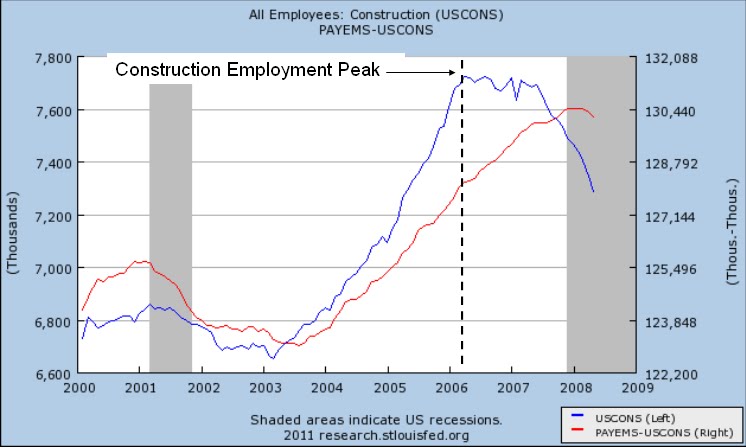
David Beckworth illustrates the other view nicely in the following graphs, 

Here we see construction employment versus total employment less construction employment

You can see these graphs, along some other ones, on Beckworths blog, these posts. Beckworth has something to say about labour mismatch problem here

So we see that NGDP, as employment, was stable for more that a year after the subprime problems started surfacing. I think this shows that the reallocation between sector that were hit structurally and other sectors that needed new workers (employment kept growing) was happening in a stable environment until 2008.  The adjective “great” has accompanied this recession only in the mentioned Q3 of 2008 when Fed for various reasons and policy errors failed to react to the growing money demand causing a fall in the NGDP causing the “Great” Recession.

Or how Beckworth puts it

focus on 2006-2008 period and see that the structural changes did not require a collapse in AD.


I believe this inter-sectoral “unwinding” and restructuring could have occurred in a less messy environment in case Fed was following its own inflation target and saw the breakeven inflation which tanked, as an obvious sign that money is tight. So while I do believe we have structural problems caused by our governments exstensive action in the markets, I do think the recession could have been milder if , first the Fed, and ECB, reacted because they recognized they have passively tightened the money supply causing NGDP to dip in the second half of 2008, and later 2009 which was a recession year.

“Even if we accept the claims that tight money made the recession much worse, monetary policy didn’t cause the recession. At least not single-handedly.”

I basically agree. It is Feds only job, as an monopoly issuer of currency to accommodate the demand for the reserves/currency. Fed didn’t cause the recession, but it did turn it into a “Great” Recession. Government, creating a terrible system to advance a political goal caused, bigger than usual, structural problem in economy, with repercussions to the financial sector, which would probably cause a recession, albeit a milder one than the one we are experienced (ing?).
Now I do have a “moral” problem with all of this – and it’s the one Vuk is talking about, and it is the reason why I used to think recession will be a good thing. I hoped the crash will be a push for people and the politicians to support reforms. Unfortunately, this crisis is a fault of capitalism, at least that is what most of the people believe. Radical policies that constrain freedom of individuals are enacted, which will in my opinion cause a lot of suffering. 
20th century was the battle for the freedom of nations, 21st, seems to me, will be the one where we will fight for the freedom of the individual.
I obviusly still have a lot to learn from writing of people like the late professor Buchanan.

That’s why I was, in a way, a proponent of the German push for reforms in the Europe periphery, and against any easing by the ECB. I saw it as mimicking Bundesbank’s orthodoxy and resistance to help politicians in any way, so the only thing that was left for them to do was reform. I admit, I never thought there would be this much resistance. I think public in most countries isn’t grasping the reality that currently they don’t have any other option.
In the comments Vuk did write he doesn’t believe Fed can start necessary restructuring. And I agree. But Fed can create environment where such restructuring will be easier to carry out. It is important that Fed adopts a rules based policy that will not distort relative prices, unlike current discretionary measures that are altered every year. I think Vuk would also agree that restructuring in the Euro Area periphery is easier now when Draghi assured markets that he will do “everything necessary”. So the outlook is more stable and policy makers can concentrate on doing the reforms. The period before that was just awful. We had urgency meetings of the Euro club countries every now and then, because different measures they were proposing, together with some irresponsible economists calling the end of euro, were roiling the markets. Policymakers focused on the markets instead of focusing on reforms. That was noticed in the public, which, again, blamed “capitalism”, bankers, Angela Merkel for all their misery. Now environment is much friendlier to talk about the ways Euro area, and the EU can improve their institutional setting. How responsible would it be if Cameron held his EU speech a year ago? Here I must say that I do agree with Jens Weidmann, who is worried about the effects various rescue funds will have for the future of the Euro, since they do create “uncomfortable” feeling of additional moral hazard in the system. And when you compare effects Draghis words had on the markets, after so much taxpayer money thrown into these funds and different bailouts, one can see why a good monetary policy is not the panacea, but it can offer a helping hand. With more CB guidance/activity markets will lend a hand too.

Bottom line:  Don’t observe the idea of NGDPLT targeting and its effects form a perspective of temporary stimulus, even in this economy.

New target doesnt have to mean going back to pre crisis level and continuing the precrsis path. A new one can be started from this point.

Monetary policy can’t fix structural problems but it can create environment where the whole thing doesn’t have to be messy as now.

UPDATE: I just found a interesting response by Lars Christensen to George Selgin, on similar questions as Vuk’s so take a look. There, you can find links to the responses of some others of the market monetarist bunch, as well as some  recommended posts on the topic.


+
Heres Sumner and Beckworth discussing some of the basics about NGDPLT. Too bad, there weren’t more questions at the end.


Read More
1 2